
Strategic Game Design
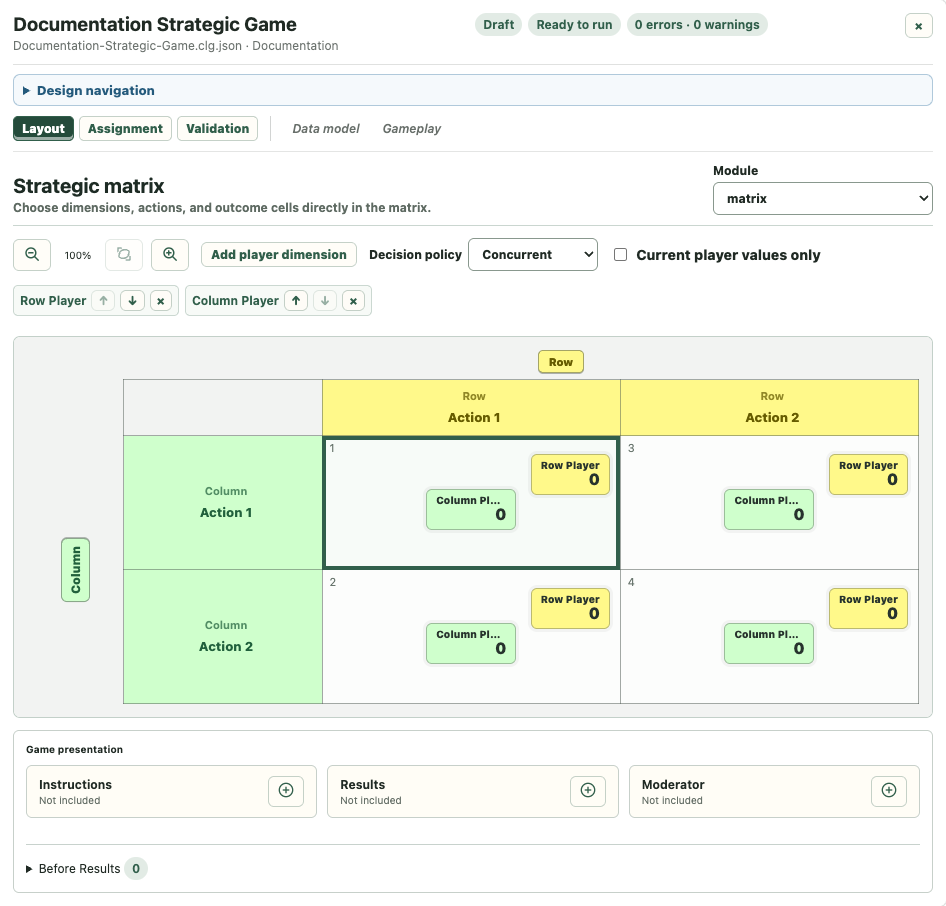
Strategic Design edits the payoff matrix directly. The Layout is the primary editor and stays synchronized with Assignment.
Assignment First
Use Assignment to add Player Types and Players, set the number of participants, and define rounds and randomization. Strategic actors and payoff recipients are drawn from this assignment.
Changing a Player Type name updates the author-facing matrix labels while stable identity keeps formulas and references attached.
When Players have no assignment conditions, their order in Assignment determines which role each seat receives. The assignment preview uses simulated seats Subject1, Subject2, and so on. In a live room, seats are filled in join order, so a participant's login name need not match their assigned seat. The player view shows both when they differ.
Matrix Layout
The Layout shows decision dimensions, actions, and outcome cells. Select an actor or action label to edit it directly. Select a payoff value in a cell to open the formula editor.
Use the zoom controls above the matrix to enlarge or reduce the canvas. The reset control returns it to 100%; zoom changes only the editor view, not the game definition.
The matrix expands when actions or dimensions are added and preserves existing outcome-cell identity and formulas where the structural change is unambiguous.
Use the up and down arrows beside a decision dimension to change its position in the matrix. The matching action combinations keep their outcome cells and payoff formulas; this does not change Player Type order in Assignment.
Axis positions determine the matrix's rows and columns. Payoff colors and positions match between Design and play.
Decision Policy and Nature
- Concurrent: the participating actors choose without seeing the other choices for that decision.
- Sequential can be represented in the definition, but the current Strategic runtime supports concurrent decisions only.
Nature is optional. A game described without Nature keeps only the player decision axes. Open Gameplay and expand the Nature dimension in Strategic Form settings: each Nature action has a Weight field. Set nonnegative weights for every outcome, with at least one positive weight; they do not need to total 1. For example, 9 and 1 give 90% and 10%. If every field is blank, the outcomes are equally likely. Nature is drawn once per round, regardless of its axis position.
The runtime uses the same canonical matrix definition shown in Layout.
Payoff Recipients
Every outcome cell uses the same ordered recipient list. Adding a recipient appends a payoff entry to every cell. Removing a recipient removes that position consistently.
Each payoff is a formula, so it may use constants or references available in the game definition. A minimal matrix should have a payoff formula for each intended recipient in every reachable cell.
Structural Editing
When adding or removing actions, review all affected cells. The editor preserves values when coordinates still correspond clearly and refuses ambiguous transformations rather than silently moving payoffs.
Game Presentation
Instructions, Results, and Moderator content use the shared three-column Game presentation editor. Their Pages, Audience rules, Variables, Choices, and Images behave like Pages in the other game types. Use Data model to define Variables referenced by payoff formulas or Pages.
Pre-Run Check
Before execution, confirm:
- Assignment contains all actors used by the matrix,
- every decision dimension has the intended actions,
- concurrent or sequential policy is correct,
- every outcome cell has the expected payoff recipients and formulas,
- Validation contains no errors.
For dimensions, Action values, outcome coordinates, recipient synchronization, and structural preservation, see Strategic Form Settings Reference.